


When I began writing the first novel, I had not yet fully outlined the world in which the story would unfold. Myoo already existed in my imagination, but only in an early form, with many aspects still to define. I knew what I needed to begin telling the story, while the rest would take shape as I wrote.
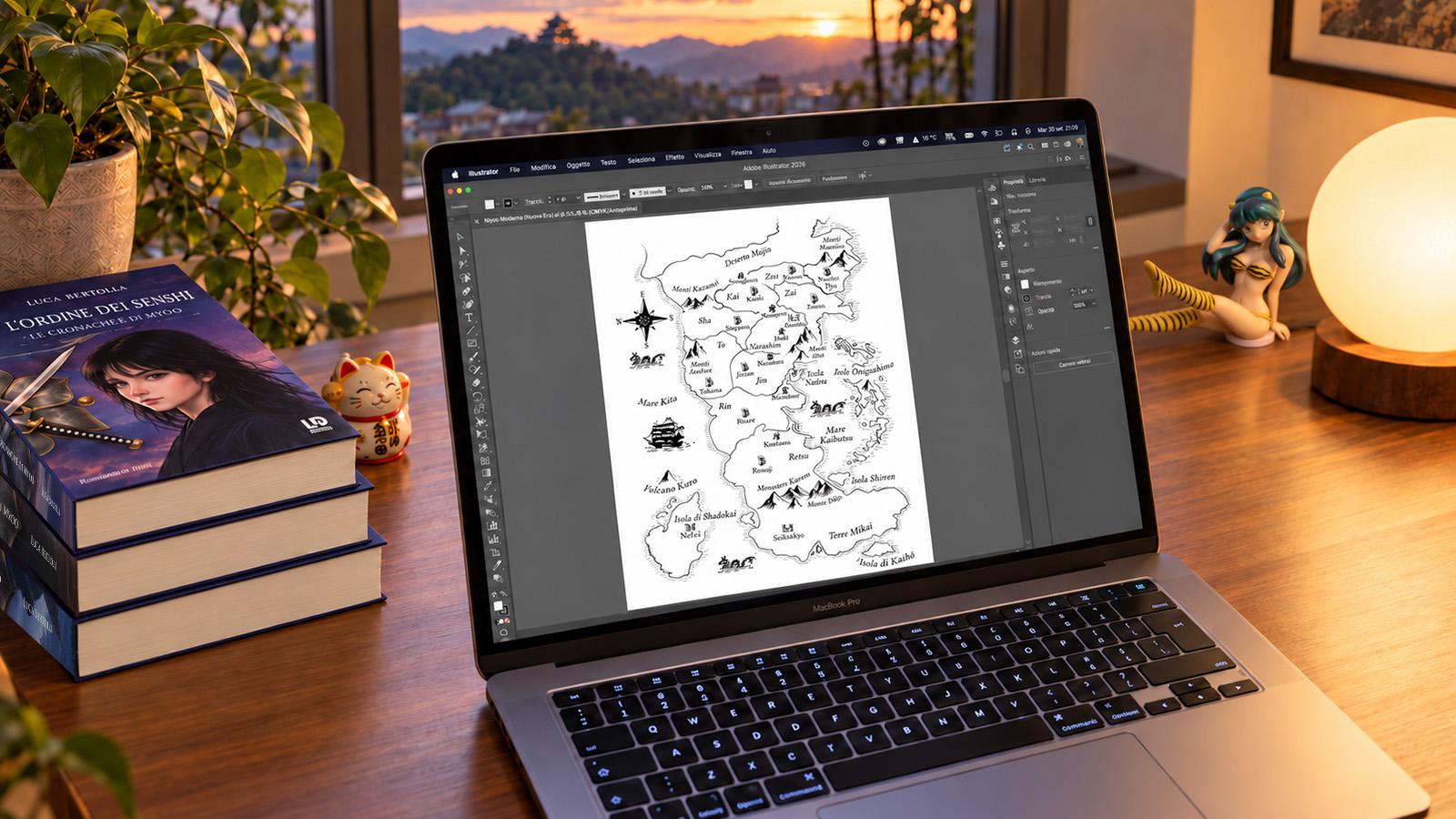
I opened Illustrator and tried my hand at creating the first version of the map. I invented the kingdoms and their capitals, drew mountains and seas, and began placing the locations I would travel through alongside the characters. Seeing them on the map helped me imagine them within the story, understand where they stood in relation to one another, and see which territories lay between them.
Alongside the geography, I began establishing the basic political framework. I needed to understand how those territories were governed, what relationships existed between the kingdoms, and how their decisions might influence the events of the novel. These were still the foundations of a system I would develop and refine over time.
I had not planned everything before writing. The world grew alongside the story, and each new element led me to consider something that had remained in the background until then. A journey required a better understanding of a territory, an encounter might suggest a custom, and the use of magic made it necessary to establish what it could do and where its limits lay.
Over time, I introduced deities and keepers of magic, developed the monetary system, and populated Myoo with animals, insects, and plants native to that world. These elements also became part of the characters’ lives. They needed to move through an environment with an identity of its own, with creatures to encounter, plants to recognize, and coins to use when paying for a room or buying something.
Magic required the same attention. The greater its role in the story, the more important it became to define how it worked. Its rules had to remain consistent from one book to the next, even when the story led me to explore new aspects of it.
Developing the different Eras added another dimension to this work. Telling the story of Myoo’s past means returning to the origins of things that already exist in the novels set later in its history. A place, an object, or a choice may have a much older story than the one readers know, and writing it allows me to build connections between books set far apart in time.
This also means paying attention to what I have already written. A new idea must find its place in the world without contradicting what happened before. Sometimes it expands on an existing detail; other times, it leads me back to a passage to make it consistent with what I am developing.
Over time, I also redrew the maps, creating different versions for different Eras. A single map was no longer enough to represent Myoo throughout its history, because the places and the way its territories were organized had to reflect the period in which each story took place.
That first version of Myoo became a fantasy world with its own religions, a defined political system, and precise rules of magic. It was not all there in the first map, or even in my head when I began. Much of it emerged as I wrote, guided by the needs of the stories and my curiosity to learn more about the world in which I had set them.
Even today, when I imagine a new novel or short story, I sometimes discover something about Myoo that I had not considered before. It is one of the reasons I still enjoy returning to it, even after so many books.